

You may not notice that the express bags, food cling film we come into contact with every day, and even the packaging films used in industrial production have all undergone a rigorous physical test-tensile test. This test does not focus on appearance, but on actual performance: how strong it is, whether it can withstand pulling, and whether it will break easily. Today, let's talk about the tensile test of plastic films with these pictures.
Why Conduct Tensile Tests on Films?
Let's think of a scenario: when you unpack a package, do you worry that the bag will tear and the contents will fall out? Or when you use cling film to wrap a bowl, do you fear it will break when stretched? These issues are actually closely related to the tensile properties of the film.
The significance of the tensile test is to conduct a comprehensive inspection of the film:
- Safety Assurance: Films used for food packaging and medical supplies must reach a certain strength to avoid damage during transportation and use, which could lead to contamination or leakage.
- Cost Control: If the film is not strong enough, it has to be made thicker during production, which naturally increases costs. The test helps us find the optimal formula and thickness that meets the required performance while balancing cost.
- Compliance with Standards: Different industries have different requirements. For example, the tensile strength of food-contact materials must comply with national or industry standards, and the test is the core basis for compliance.
How is the Tensile Test Conducted? (Follow the Pictures for the Whole Process)
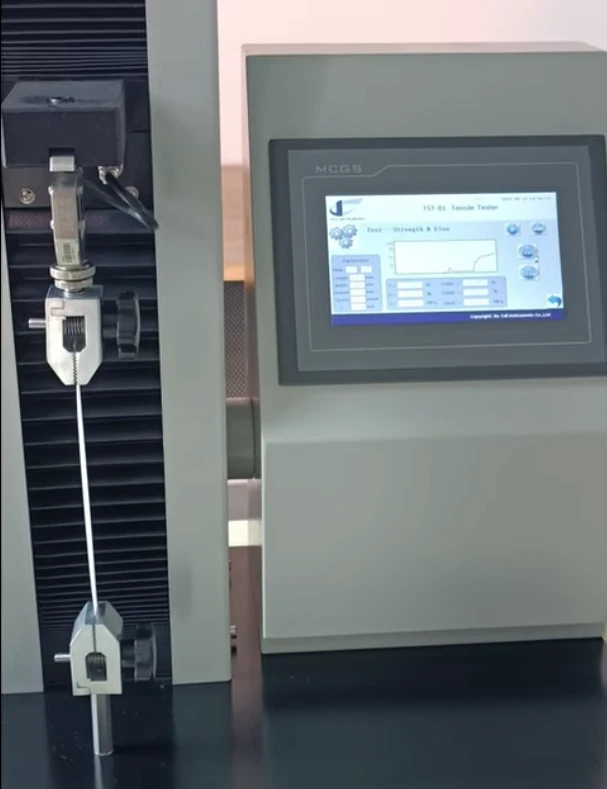
1. Equipment: Precision Physical Tester
First, look at the first picture. This is the core equipment for plastic film tensile testing-the electronic universal testing machine. Its touch screen can display test data in real time, such as tensile force, displacement, and stress-strain curve, just like an electrocardiogram for the film, capturing every slight change in force accurately.
Before the test, we cut the film into standard-sized samples and clamp both ends firmly with fixtures. The design of the fixtures is crucial: they must hold the film securely without damaging it, otherwise the test results will be inaccurate.

2. Force Application: The Deformation Process of the Film
In the second picture, the film is pushed up by a plunger, gradually forming a cone shape. This is actually another force application scenario-burst test, which, like the tensile test, tests the toughness of the film. You can see that the film is stretched very thin but still does not break, which is a direct reflection of its durability.
In a conventional tensile test, the equipment pulls the fixtures at both ends at a constant speed, applying uniform tensile force to the film. As shown in the third picture:
- Stage 1: The film is clamped stably and ready for testing.
- Stage 2: Stretching starts, and the film gradually lengthens with slight deformation.
- Stage 3: The tensile force increases gradually, and the film enters the plastic deformation stage, becoming thinner and narrower.
- Stage 4: The ultimate force is reached, the film breaks, and the test ends officially.
During the entire process, the equipment records data dozens of times per second, accurately capturing every step of the film from being intact to breaking.

3. Data: Understanding the Film's Test Report
After the test, the equipment generates a detailed report, among which several key indicators need to be focused on:
- Tensile Strength: The maximum tensile force the film can withstand, measured in MPa. The higher the value, the stronger the film. For example, express bags need sufficiently high tensile strength to carry heavy loads.
- Elongation at Break: The percentage by which the film is stretched before breaking, mainly reflecting its flexibility. For cling film, a high elongation at break allows it to wrap various shapes of containers easily; while some industrial films often require a moderate elongation to balance strength and processability.
- Yield Strength: The turning point where the film changes from elastic deformation (able to rebound after stretching) to plastic deformation (unable to recover after stretching). This indicator is crucial-once the yield strength is exceeded, the film will undergo permanent deformation, directly affecting its use effect.
What is the Use of These Test Results?
The test is not a formality in the laboratory; these data directly affect every layer of film we use:
- Formula Optimization: If the test finds that the film's strength is insufficient, researchers will adjust the formula, such as adding tougheners or changing the polymer molecular weight, to make the film more durable.
- Quality Control: During mass production, each batch of film is sampled to test its tensile properties. If the strength of a certain batch drops suddenly, problems can be found in time to prevent defective products from entering the market.
- Selection Reference: When customers choose films, they put forward requirements according to the use scenario. For example, cold chain packaging requires low-temperature resistant films, and the test can clarify which formula can still maintain good tensile properties in low-temperature environments.
In Conclusion
The tensile properties of plastic films are the core of product quality control, directly determining their safety, reliability and applicability. As a key testing method, tensile testing is an important measure for us to adhere to quality bottom lines and ensure product compliance. We always adopt strict standards and professional capabilities to conduct rigorous tests on each batch of products, accurately control core indicators, and prevent unqualified products from entering the market.
From formula R&D to quality acceptance, we uphold a responsible attitude at every step, guard product quality with professional testing, and provide customers with high-quality products that meet industry standards and actual needs, effectively protecting the rights and interests of customers and end users.