

Executive Summary
By 2026, coffee packaging is no longer a supporting function.
For large buyers, it has become a strategic decision layer that directly affects:
⑴ Regulatory compliance
⑵ Supply chain risk
⑶ Long-term cost control
⑷ Brand scalability
Key shift:
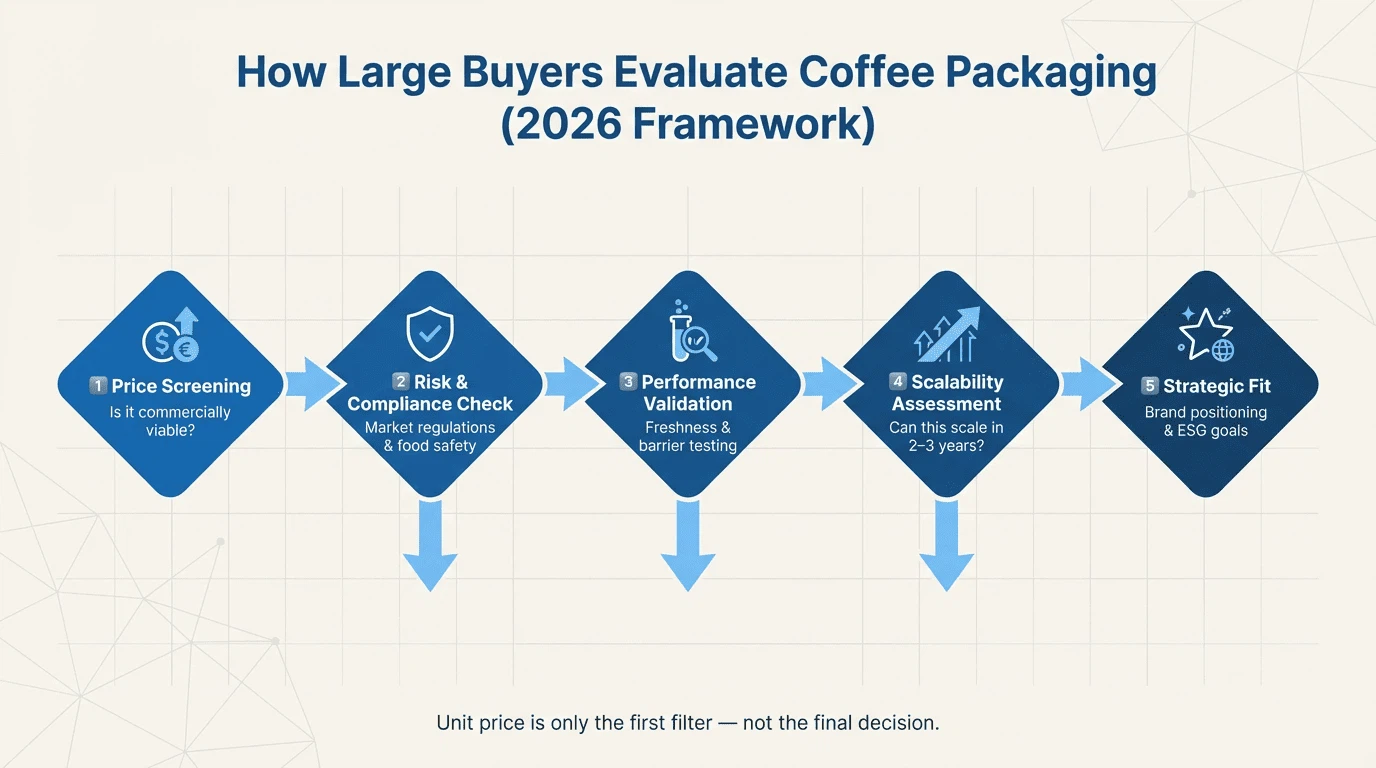
Large buyers are moving from price-driven packaging decisions to risk- and system-driven procurement models.
This white paper summarizes:
Ⅰ. The most relevant global coffee packaging trends for 2026
Ⅱ. What large buyers are actively preparing for
Ⅲ. Practical actions procurement teams can take today
Why Coffee Packaging Is Now a Strategic Procurement Issue
For many years, packaging decisions focused on:
Unit price,Visual appeal,Short-term availability,That model no longer works.
What has changed:
- Sustainability regulations are tightening globally
- Cross-border logistics are longer and riskier
- Retailers are raising compliance thresholds
- Brands are scaling faster across markets
Result:
Packaging failures now lead to delays, relaunch costs, delisting risks, and margin erosion.
For large buyers, packaging is no longer an operational detail - it is a risk management tool.
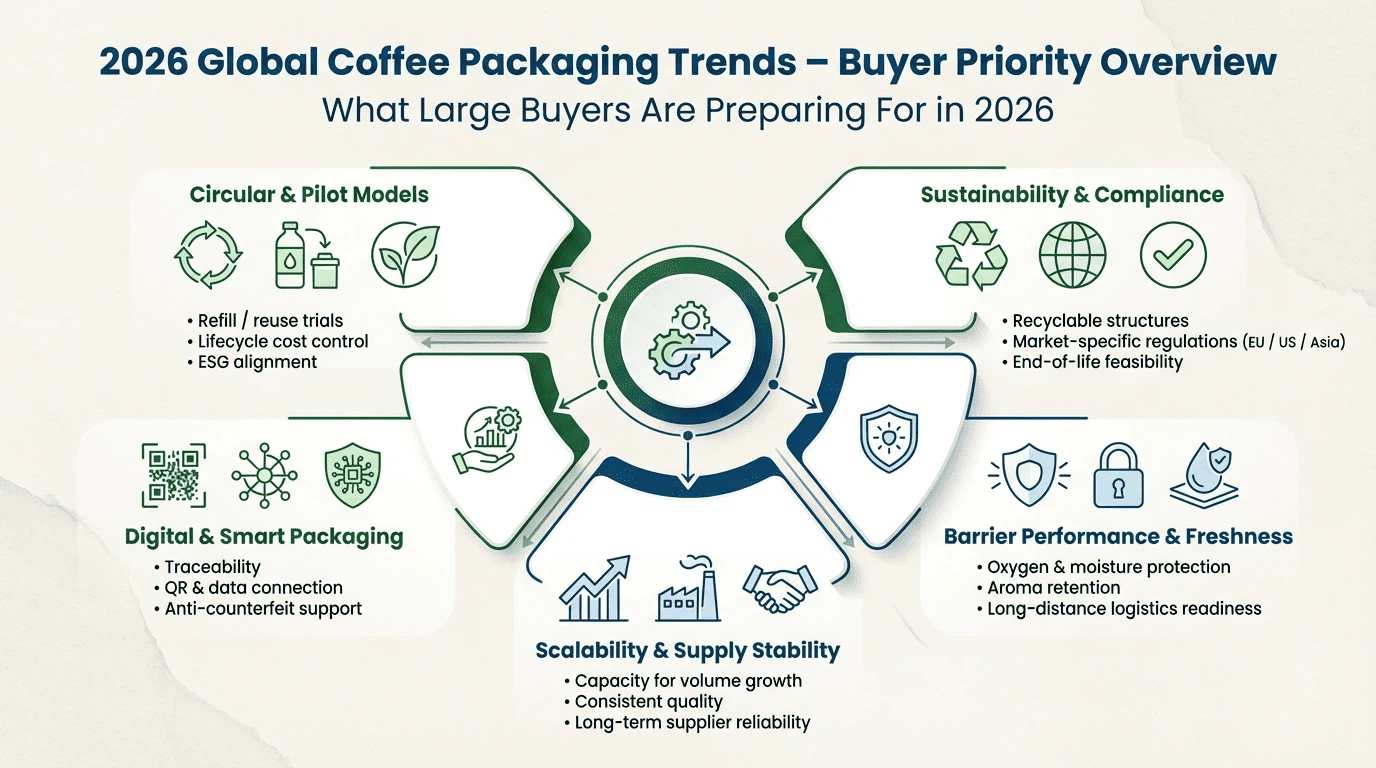
2026 Trend #1: Sustainability Is a Market Access Requirement, Not a Marketing Choice
What many brands misunderstand
Choosing "eco-friendly" materials does not guarantee:
Regulatory acceptance,Retail approval,Real recyclability
What large buyers are preparing for
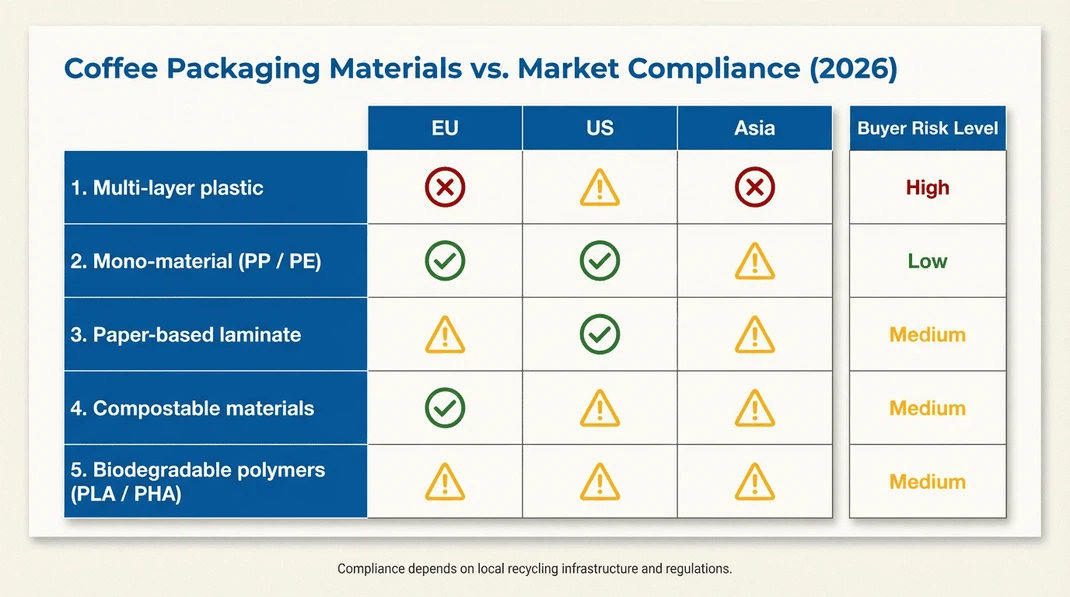
- Region-specific compliance (EU ≠ US ≠ Asia)
- Shift toward mono-materials and recyclable structures
- Stronger scrutiny of end-of-life feasibility, not just material claims
Overlooked but critical detail:
Many "compostable" or "biodegradable" coffee packages fail in markets without industrial composting infrastructure - creating hidden compliance risk.
Procurement action:
Build a material + region compliance matrix before approving any packaging structure.
2026 Trend #2: Barrier Performance Is Becoming a Cost-Control Strategy
Coffee freshness loss is no longer treated as a quality issue alone - it is a financial risk.
What large buyers prioritize:
- Oxygen & moisture barrier performance
- Aroma retention during long-distance shipping
- Stability across extended shelf life
Key insight:
- Lower unit-cost packaging often increases:
- Product waste
- Customer complaints
- Return and replacement costs
- Total Cost of Protection now outweighs Unit Price.
Procurement action:
Evaluate packaging using Total Cost of Ownership (TCO), not per-unit cost.
2026 Trend #3: Packaging Decisions Are Tied to Scalability
Large buyers are designing packaging not just for today's SKU, but for:
Multi-market expansion,Future volume growth,SKU extensions
Common large-buyer priorities:
- Stable supply capacity
- Consistent quality across batches
- Flexible MOQ and format adaptability
Overlooked risk:
Packaging that works at small scale often fails at volume - causing forced redesigns mid-growth.
Procurement action:
Assess supplier capability for 2–3 year scalability, not current demand only.
2026 Trend #4: Smart & Digital Packaging Is Quietly Entering Procurement Requirements
While often discussed as a marketing tool, smart packaging is now used for:
Traceability,Anti-counterfeit measures,Supply chain transparency
Large buyers increasingly view QR codes and digital identifiers as:
- Compliance support tools
- Internal data assets
- Risk monitoring mechanisms
Procurement action:
Include digital traceability capability in supplier evaluations, even if not immediately deployed.
2026 Trend #5: Circular Economy Models Are Emerging - Slowly but Strategically
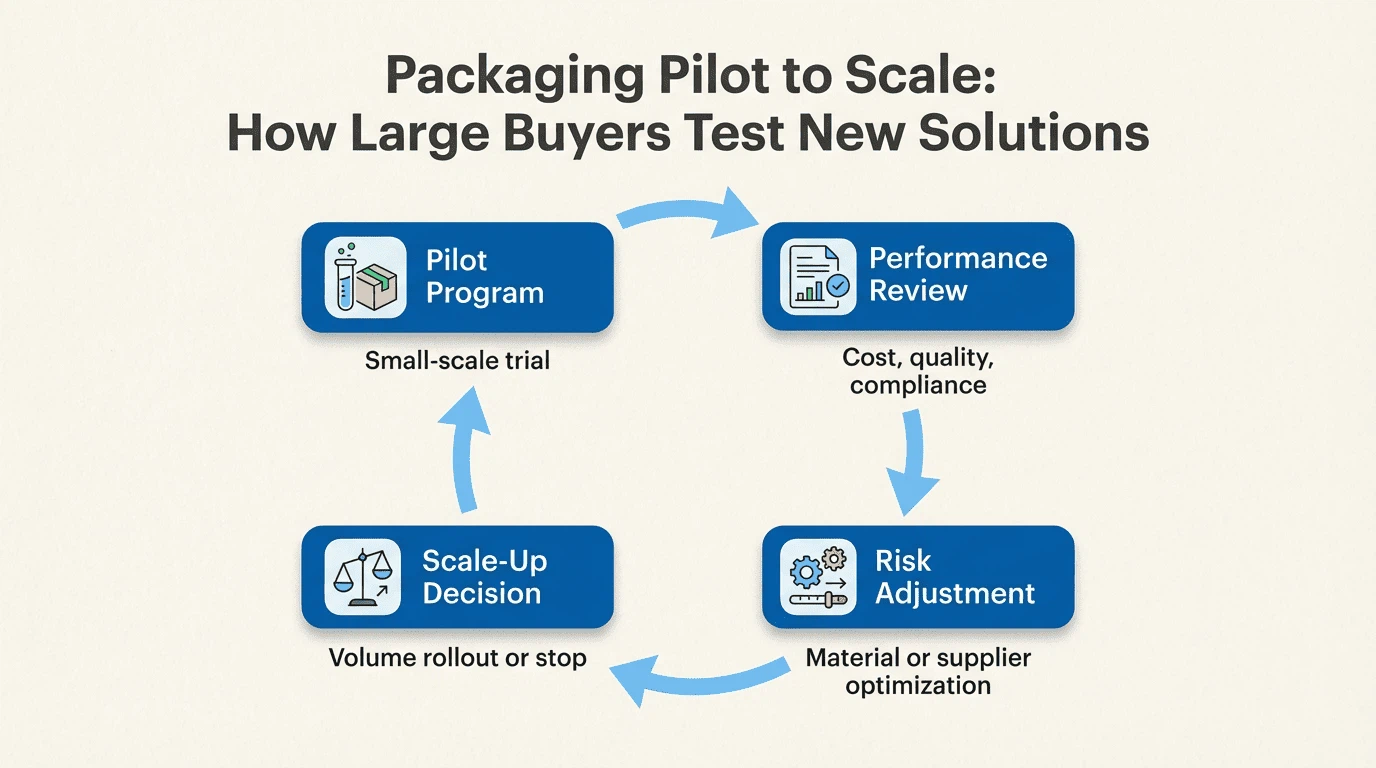
Reusable, refillable, or take-back packaging models are still niche - but large buyers are:
Running pilots,Testing subscription-based packaging loops,Evaluating lifecycle cost savings
Why this matters:
Circular models can reduce long-term material volatility and strengthen brand loyalty.
Procurement action:
Identify suppliers capable of supporting pilot-scale circular packaging programs.
Common Packaging Mistakes Large Buyers Are Actively Avoiding
Based on market observations, large buyers are moving away from:
❌ Choosing packaging based on price alone
❌ Selecting materials without market-specific compliance checks
❌ Over-customizing designs that limit scalability
❌ Ignoring recycling infrastructure realities
❌ Treating suppliers as short-term vendors instead of long-term partners
What Large Buyers Are Preparing for Now (2026 Readiness Checklist)
Large procurement teams are already:
✅ Mapping packaging materials to target market regulations
✅ Auditing suppliers for long-term capacity and compliance
✅ Shifting evaluation metrics from price to risk & performance
✅ Planning packaging strategies aligned with 2–3 year growth
✅ Treating packaging as part of brand and supply chain strategy
Conclusion: Packaging Is Becoming a Strategic Advantage
In 2026, coffee packaging is no longer just a container.
For large buyers, it is:
A compliance gateway
A freshness protection system
A scalability enabler
A risk management layer
Buyers who prepare early will reduce friction, control cost, and move faster - while others react under pressure.
About This White Paper
This insight is based on global market data, packaging industry analysis, sustainability research, and procurement-level observations across coffee brands and food packaging supply chains.