

Whenever a coffee bag bloats or leaks, the one-way degassing valve is usually the first to take the blame. But in all honesty, the valve itself is an incredibly simple and clever little device-just a plastic base, a rubber membrane, and a tiny drop of silicone oil. As long as it comes from a reputable manufacturer, the chances of it inherently being defective are extremely low.
So why do valves still cause problems from time to time in real-world applications? I want to take this opportunity to skip the dry, theoretical manuals and share a few real-life cases of valve failures I've personally encountered during packaging tests and production line inspections.


An Unexpected Culprit: Coffee Dust Particles
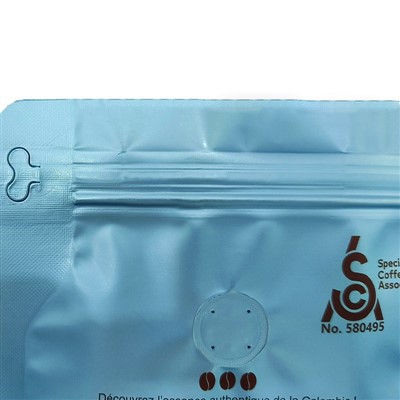
Do you know how a degassing valve actually works? It relies on the pressure of the carbon dioxide inside the bag to push open the rubber membrane, which is coated with silicone oil. Once the gas is released, the surface tension of the oil pulls the membrane back tight, keeping outside oxygen from getting in.
Last year, we worked with a specialty coffee brand. They launched an ultra-fine ground espresso drip bag and coffee powder, using the same batch of valved bags. It didn't take long before customer service started receiving complaints: "The coffee lost its aroma" or "It's slightly damp."
I cut open the returned bags, carefully removed the valves, and put them under a microscope. Sure enough, the silicone oil layer between the membrane and the base was completely packed with microscopic coffee dust.
For finely ground coffee, if dust extraction isn't handled properly during filling, or if the bags experience severe bumping during transit, the dust kicks up and sticks inside the valve. Once dust gets trapped in the rubber membrane, the valve can't seal tightly anymore. Outside oxygen rushes right in, and naturally, the coffee goes stale. The only way to completely fix this issue was to switch to a specialized valve with a high-density filter.
Errors in the Heat-Sealing Process: Incompatibility Between Film and Valve
Once, a client chose a foil laminate film with excellent barrier properties and very high stiffness. Everything was perfect during sampling, but as soon as we started mass production and applying the valves, we saw about a 3% bloating rate due to valve failure.
We checked everything and confirmed the valves themselves were fine. It was only after reviewing the production line that we caught the real culprit: a mismatch between the heat-sealing process and the film material.
The valve applicator machine uses high heat to fuse the valve base to the inner layer of the composite bag. Because the film the client chose was quite stiff, and the heat-sealing temperature that day was set just a tiny bit too high, the combination of heat and pressure caused the valve base to warp slightly-a deformation almost invisible to the naked eye.
Once the base warps, the rubber membrane inside can no longer sit perfectly flat, ruining the liquid seal of the silicone oil. Some valves got stuck shut, preventing degassing and causing bloating, while others leaked. This incident made me deeply realize that a degassing valve doesn't exist in isolation. It must perfectly match the flexibility of the packaging material, the melting point of the inner film, and the machine's sealing temperature. A miss is as good as a mile.


Extreme Logistics Environments: The Loss of Silicone Oil
Finally, let's touch on a blind spot often overlooked by international export clients: the impact of extreme logistics environments on the valve's silicone oil.
That single drop of high-purity silicone oil is the soul of a functioning one-way valve. I once handled a sea freight shipment heading to the Middle East. The client reported that upon arrival, some of the valves seemed completely blocked. We simulated the high-temperature and high-humidity environment of a shipping container near the equator and added a long-term heavy pressure test. We found that under extreme heat and continuous pressure, the silicone oil in some cheaper valves can volatilize or leak out. This causes the rubber membrane to dry out and stick together, ultimately preventing the carbon dioxide from pushing it open normally.
A Final Thought


So, the next time you find a coffee bag bloating or leaking, don't rush to convict the valve. It might have swallowed too much dust during filling, suffered internal injuries during the heat-sealing process, or endured the brutal torture of international shipping.
Packaging design itself is a systematic engineering process that requires a comprehensive evaluation of materials, equipment, product characteristics, and the logistics chain. That's exactly why we ask so many detailed questions when providing coffee packaging solutions for our clients.
Have any of you encountered similar incidents in your daily coffee production or packaging procurement?
do you have any question?

Q:Can I use the same valve for all coffee types?
A: No. High-density filter valves are mandatory for fine-ground coffee to prevent dust clogging, while standard valves are fine for whole beans. Always match your valve type to your product's grind size.
Q: Why does the valve look deformed after heat-sealing?
A: It's likely a heat-sealing error. If the temperature is too high or pressure is uneven, the valve base warps, breaking the internal seal. Always calibrate your sealing equipment whenever you switch film types.
Q: Is bloating always bad?
A: Not always. A slight, firm pillow-like swell is normal for fresh-roasted coffee. It only becomes a "failure" when the bag feels rock-hard and ready to burst, or if it leaks when pressed.