

For granola brands, packaging is much more than just a container. It directly impacts product protection, logistics costs, shelf presentation, and the consumer experience. While rigid cans offer a sturdy and premium feel, their low space utilization during warehousing and transportation significantly increases costs. Brands today strive to optimize packaging expenses while maintaining product quality, making flat-bottomed bags a highly valuable alternative.
I. Why Consider Replacing Rigid Cans?
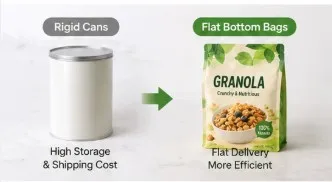
Rigid cans maintain their shape well and are reusable. However, their fixed size presents logistical challenges: empty cans occupy considerable space before filling. For brands ordering packaging in bulk, this increases warehousing needs and inbound transportation costs-a situation businesses want to avoid.
II. Why Choose Flat Bottom Bags?
Flat bottom bags perfectly address these pain points. They are supplied flat, occupying minimal space before filling; their flat bottom allows for independent shelf display, combining the space advantages of flexible packaging with retail display requirements.
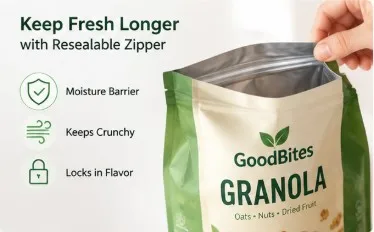
Their advantages extend beyond logistics. Switching to flat bottom bags reduces packaging components, supports lower minimum order quantities, and offers greater flexibility for new brand launches and packaging redesigns.
However, not all flexible packaging bags deliver the same shelf-ready look. Standard stand-up pouches have accordion pleats at the bottom, while flat-bottomed bags feature a more defined bottom and side accordion pleats, creating a box-like appearance. For granola brands moving away from rigid cans, this structure offers three practical advantages.
Structured Retail Appearance
The flat base supports an upright display, while the wide front panel provides ample space for branding, product images, and key product information. The side accordion pleats also allow for graphic and information printing, providing more opportunities for flavor identification and brand messaging.
Flexible Packaging Sizes
The bag size can be designed to fit the actual weight and volume of the granola, rather than simply replicating the original can size. This helps brands strike a balance between shelf-ready performance and material utilization.
Easy to Store After Opening
The resealable zipper allows consumers to access the product multiple times. With a suitable opening design, it can be used easily without a separate hard lid.
- Press Type PE Zipper: The mainstream design, repeatedly seals to prevent moisture, protects the cereal's crispness, offers high cost-effectiveness, and is suitable for 250 g–1 kg standard packs.
- Sliding Zipper: A sliding zipper provides a more secure seal and convenient use, making it suitable for 750 g and 1 kg family packs positioned toward the higher-end market.
- Child Safety Zipper (CR): A dual-opening design (press + slide) helps prevent accidental opening by children, targeting European and American supermarkets and families, with higher costs.
- Anti-tamper Easy-Tear Strip + Zipper: An irreversible tear upon initial opening proves originality; the bag remains resealable after opening, making it suitable for online retail.
III. Material Selection: Maintaining Freshness and Taste
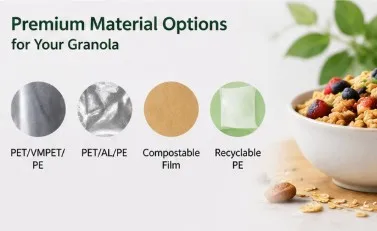
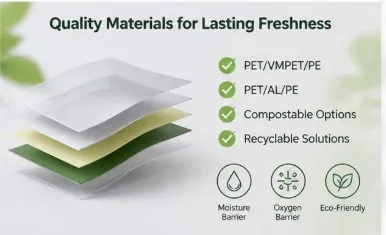
Granola cereal may contain oats, nuts, seeds, and dried fruit, each with varying sensitivities to moisture and oxygen. Moisture penetration can affect crispness, while oxygen exposure can lead to flavor degradation, especially in products containing high-fat components. Therefore, the appropriate composite material structure should be selected based on the formulation, target shelf life, distribution conditions, and storage environment.
Based on these requirements, brands may consider the following material structures for reference only:
- PET/VMPET/PE (metallized, mainstream): Barriers to moisture and oxygen, maintains crispness and flavor, offers high cost-effectiveness, can be windowed, and is suitable for most retail granola products.
- PET/AL/PE (aluminum foil): Strongest barrier properties, protects against light and oxidation, offers the longest shelf life, and is suitable for long-distance transportation and high-fat formulations.
- Kraft paper + PLA/PBAT (compostable): Natural texture, primarily for organic and clean-label brands; weaker barrier properties and shorter shelf life.
- Single-material PE (recyclable): An environmentally friendly recycling route with good printability and moderate barrier properties, suitable for brands emphasizing sustainability.
For products requiring extended shelf life, additional measures such as nitrogen rinsing can also be evaluated.
Importantly, choosing the right film alone does not determine a product's freshness. Sealing integrity, zipper construction, filling conditions, and storage temperature all affect the overall performance of the packaging. Before mass production, the proposed structure should be evaluated based on the product's actual barrier requirements.
LepuPouch, a manufacturer with over 20 years of experience in flexible plastic packaging, can assist you with packaging structure selection, sample making, and barrier testing, providing a stable and reliable packaging solution for granola.
IV. How to Maintain Brand Image After Packaging Changes
Replacing rigid cans with flexible bags will alter the product's shelf presentation. Rigid cans have a fixed shape, while flexible bags vary in shape depending on the filling volume, and wrinkles may form at the side creases. These characteristics need to be considered in advance during the packaging design phase.
Prioritize displaying the brand logo, product name, and mandatory labeling information on the front of the bag; the side creases are suitable for displaying flavor descriptions or supplementary brand information. Besides the layout of text and graphics, surface finish also significantly impacts the final visual effect: matte and glossy finishes are two commonly used surface treatments, with distinct visual styles. Matte finishes offer a restrained and sophisticated look, while glossy finishes make colors and patterns brighter and more eye-catching.
For brands with multiple granola cereal products, using a uniform bag structure paired with differentiated color schemes and graphic designs can maintain visual consistency across the entire product line and enhance series recognition. LepuPouch provides precise eight-sided sealing line files to guide your layout, preventing core graphics and key information from being wrinkled, stretched, or misaligned after filling.
V. Checklist Before Changing Packaging
Switching from rigid cans to flat-bottomed bags offers opportunities to optimize storage, transportation, packaging design, and the daily user experience.
However, the right solution depends on more than just the packaging format. Before making a transition, factors such as product volume, barrier requirements, filling equipment, and transportation conditions must be considered.
For granola brands evaluating packaging upgrade options, comparisons based on total cost, product protection, and consumer experience are more reliable than simple unit price assessments.
Looking for custom flat-bottomed bags for granola or breakfast cereals?
As a granola packaging manufacturer, LepuPouch can help you evaluate bag sizes, material construction, resealable zippers, and printing options based on your product and production needs.