


Many new brands entering the industry often spend the majority of their energy selecting green beans and perfecting roast profiles, only to stumble at the final step: packaging. In reality, the moment coffee beans leave the roaster, a battle against time, light, oxygen, and moisture begins.
Freshly roasted coffee beans are alive; they continue to release substantial amounts of carbon dioxide for several weeks. This creates a paradox: if we solely pursue absolute sealing, locking the beans tightly inside the bag, the accumulated gas will cause the packaging to inflate like a balloon, potentially even bursting during transit. However, if we sacrifice the seal to allow for degassing, external oxygen and moisture will exploit the vulnerability, rapidly oxidizing the oils and turning a complex flavor profile flat and mediocre within days. Therefore, a qualified coffee package is not merely a container; it is a micro-climate cabin that maintains the bean's lifecycle and flavor stability.
The Structural Components of a Coffee Bag
To achieve the functions mentioned above, a single layer of film is far from enough. It requires ingenious physical structures working in synergy. Based on our years of production line experience, the key to a superior coffee bag experience is often hidden in these structural details:

One-Way Degassing Valve
This is the exhaust valve of the coffee bag. It is precisely embedded into the bag body. The internal film and specific aperture structure ensure a one-way flow-when the accumulated carbon dioxide inside reaches a certain pressure, it pushes the valve open to escape, while external air cannot enter. A common, hard-learned lesson in the industry is that if a poor-quality valve is used, its closure won't be tight enough. Even a microscopic backflow of oxygen is enough to ruin a batch of expensive Geisha beans.
Resealable Zipper
Consuming a bag of coffee is a long-term process. Today's market strongly prefers built-in zippers with tear notches. After the heat seal is torn open, consumers can still rely on the zipper for high-frequency, moisture-proof sealing. The tactile resistance of the zipper's bite and the smoothness of the opening directly determine the consumer's daily user experience.
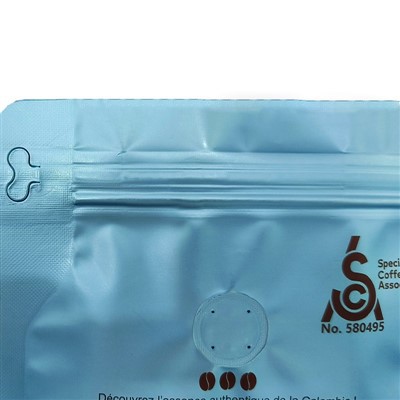

Three-Dimensional Edge Sealing
Currently, the most favored structure for premium coffee on the market is the eight-side seal. Compared to traditional three-side seals or stand-up pouches, the bottom of an eight-side seal pouch lays completely flat, offering a larger and more three-dimensional display surface on the retail shelf. Furthermore, its multi-folded structure provides higher structural strength for the heat-sealing of different composite layers, resulting in outstanding load-bearing capacity.
The Selection of Composite Materials
In the production workshop, the rolls of seemingly ordinary film we see are actually precisely engineered composite materials. It is incredibly difficult for a single polymer material to simultaneously meet printing, barrier, and heat-sealing requirements. A typical flexible coffee bean package usually employs a composite structure of three or more layers:

Outer Layer
This layer requires excellent print adaptability. Whether it's high-brightness colors or a premium matte finish, it is all realized on this layer. Simultaneously, it must possess good puncture resistance.
Middle Barrier Layer
This is the core defense line blocking oxygen, moisture, and UV rays. Pure aluminum foil offers top-tier barrier properties, maximizing shelf life, while metallized film presents a more cost-effective advantage.


Inner Heat-Seal Layer
This layer comes into direct contact with the coffee beans. It must comply with strict food-grade safety standards and be able to melt quickly and bond firmly under the high or low temperatures of the pouch-making machine, ensuring no air leaks at the edges.Knowing how to adjust the thickness and composite ratios of these materials according to different coffee product lines is one of a packaging factory's core technological barriers.