

As more food brands explore sustainable packaging, mono-material films are becoming an important option in flexible packaging development.
At the same time, brands still need packaging that looks attractive, communicates product information clearly, and maintains consistent printing quality.
This raises an important question: Can digital printing be used on mono-material films without compromising color consistency, ink coverage, or recyclability?
The answer depends on the film structure, printing technology, ink system, and intended recycling requirements.
This LepuPouch guide explores the key considerations when combining digital printing with mono-material flexible packaging, including color performance, ink coverage, material compatibility, and small-batch production.
1. What Is Mono-Material Film in Flexible Packaging?
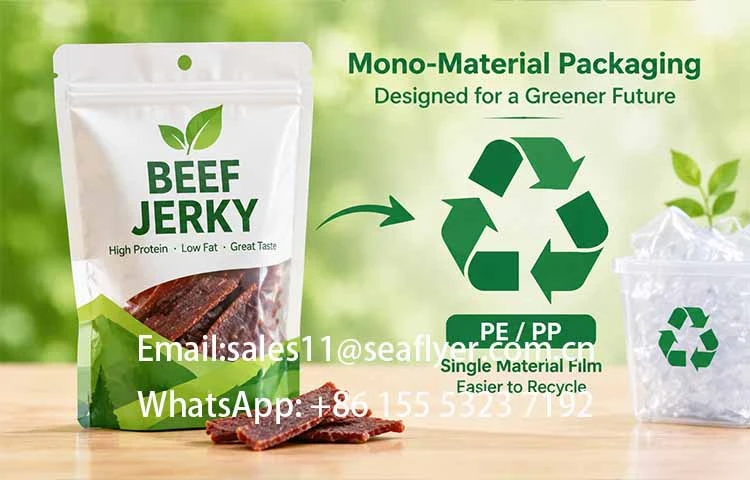
Mono-material film is a type of flexible packaging material designed primarily around one polymer family rather than combining multiple incompatible material types.
Common examples include:
- PE-based mono-material films
- PP-based mono-material films
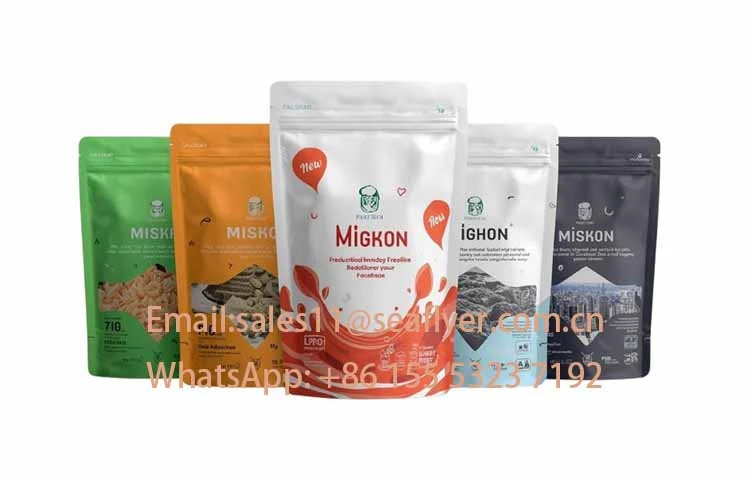
*Mono-material film: single-polymer family design for improved recyclability.
Traditional flexible packaging may combine PET, aluminum foil, PE, and other materials to achieve specific barrier and mechanical properties. Although these multilayer structures can provide excellent packaging performance, their mixed-material construction may make recycling more challenging in certain recycling systems.
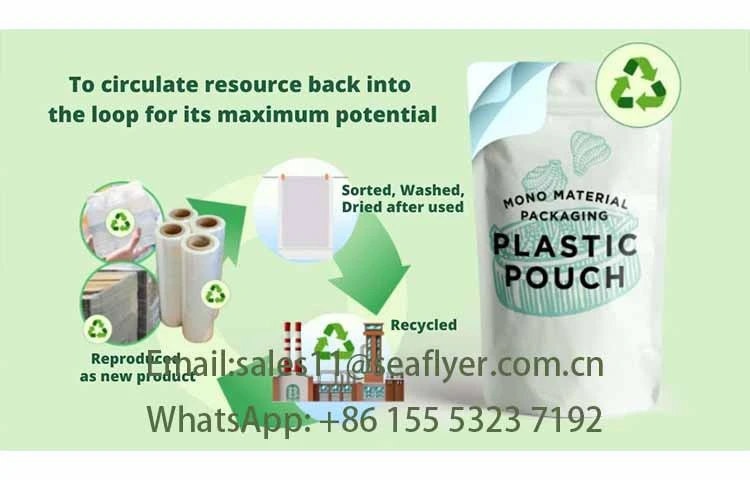
Mono-material packaging aims to improve compatibility with suitable recycling streams by reducing the use of different polymer families. However, mono-material does not automatically mean recyclable.
The final packaging design must also consider film thickness, barrier coatings, adhesives, printing inks, zippers, and other components, as well as the recycling infrastructure available in the target market.
For brands developing more sustainable packaging, selecting the right material structure is the first step.
2. Can Digital Printing Be Used on Mono-Material Films?
Yes, digital printing can be used on certain mono-material film structures, depending on the printing technology and material compatibility.
Digital printing is different from conventional gravure printing. Gravure printing generally requires printing cylinders for each design, while digital printing transfers artwork directly through a digital printing system without traditional printing plate preparation.
This makes digital printing particularly useful for:
- Small-batch packaging orders
- New product launches
- Seasonal product designs
- Multiple product variations
- Early-stage packaging tests
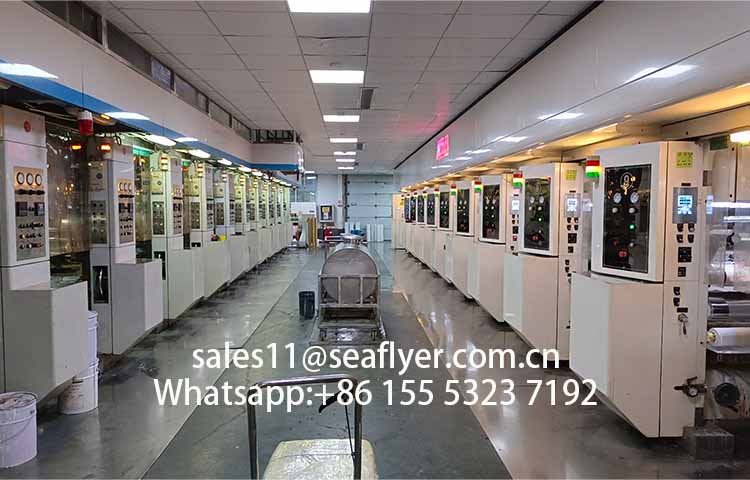
*Digital printing offers flexibility for small-batch and multiple-design projects without traditional cylinders.
For mono-material packaging, however, the film surface must be suitable for the selected ink and printing process.
Important considerations include:
- Surface Treatment: Some film surfaces require corona treatment or other suitable surface preparation to improve ink adhesion.
- Ink Compatibility: The ink system must be compatible with the selected film and intended packaging application.
- Printing Process: Different digital printing technologies may produce different results on PE-based and PP-based films.
- Lamination Compatibility: If the printed film will be laminated, the ink, adhesive, and film combination must be evaluated together.
Therefore, brands should not assume that every digital printing process can be used on every mono-material film. A material and printing compatibility test is recommended before mass production.
3. Color Consistency: What Should Brands Expect?
Color consistency is one of the most important considerations when developing custom printed packaging. For food brands, packaging colors are closely connected to brand identity. A coffee pouch, granola bag, or snack package should maintain a recognizable appearance across different designs and production runs.
Factors That Affect Color Consistency
Several factors can influence the final printed appearance:
- Film Surface and Color: Different film materials can have different surface characteristics and visual appearances. A transparent PE film, white film, and metallized film may produce different visual results even when the same artwork is used.
- Ink System: The selected ink system influences color reproduction, opacity, adhesion, and print durability.
- Artwork and Color Management: Correct artwork preparation and color management are important for achieving predictable printing results.
- Printing Conditions: Printing equipment, material conditions, and production parameters can all influence the final result.
How to Improve Color Consistency
Before approving a packaging design, consider:
- Providing high-resolution, print-ready artwork
- Using consistent color specifications
- Confirming the film's surface and background color
- Reviewing physical printed samples
- Establishing an approved color reference for future production
Note: It is important to remember that digital and gravure printing may produce slightly different visual results. If exact brand color matching is critical, a physical sample should be reviewed before production approval.
4. Ink Coverage: Why Does It Matter on Mono-Material Films?
Ink coverage refers to the amount of printed area covered by ink in a design. A simple design with a white background and a small logo generally requires less ink coverage than a package featuring full-surface printing with large solid-color areas.
This can affect both print appearance and packaging performance.
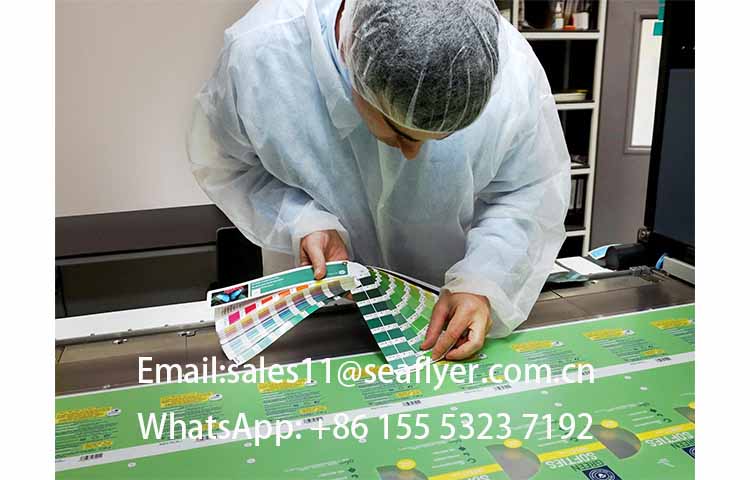
*Ink coverage comparison: full-surface printing (left) vs. minimal design (right).
Heavy Ink Coverage
Large solid-color areas may require more careful evaluation. Potential considerations include:
- Ink adhesion to the film surface
- Ink curing or drying performance
- Print uniformity
- Surface durability
- Compatibility with lamination
- The effect of inks on the overall recycling design
Light Ink Coverage
Designs with limited printed areas may offer greater flexibility during packaging development. For example, a minimal design with a small logo, product information, and selected color elements may be easier to evaluate than a design featuring extensive full-surface coverage.
However, light ink coverage does not automatically guarantee better recyclability. The ink chemistry, total ink load, printing process, and recycling system all matter.
Practical Design Recommendations
When developing digitally printed mono-material packaging, consider:
- Avoid unnecessary full-surface ink coverage when it is not essential to the design
- Confirm that the selected ink system is suitable for the film
- Evaluate ink adhesion and surface durability
- Test the complete printed and laminated structure
- Review recycling compatibility based on the intended market
The objective is to achieve an attractive design without introducing unnecessary complications into packaging performance or recycling.
5. Does Digital Printing Affect Mono-Material Packaging Recyclability?
This is one of the most important questions for brands considering sustainable flexible packaging.
The short answer is that digital printing does not automatically make mono-material packaging non-recyclable, but printing inks and other packaging components must be considered.
A package may use a PE-based or PP-based structure, but its actual recycling compatibility depends on the complete package design.
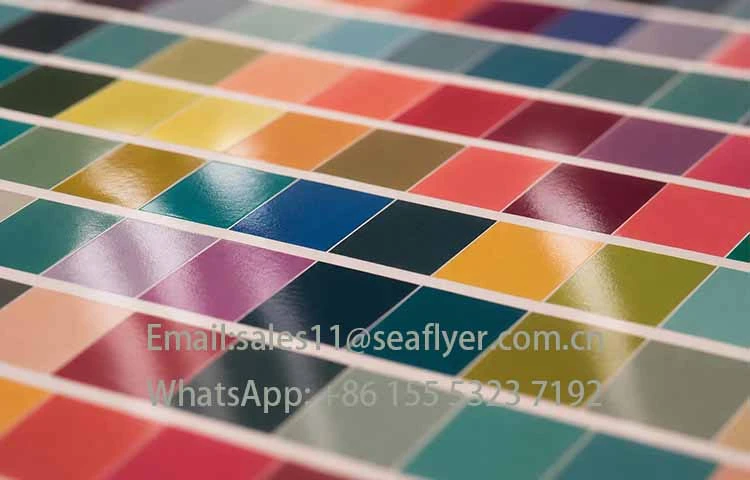
*Recycling evaluation: complete package assessment including ink, adhesives, and components.
What Should Be Evaluated?
- Ink Chemistry: Different ink systems have different compositions and properties. Their compatibility with the intended recycling process should be assessed.
- Ink Coverage: The amount of ink and printed surface area may influence the overall recycling assessment.
- Adhesives and Coatings: If the packaging uses lamination adhesives, protective coatings, or barrier layers, these should also be included in the evaluation.
- Additional Components: Zippers, valves, labels, and other accessories may affect the compatibility of the complete package with recycling systems.
- Target Market: Recycling requirements and available infrastructure vary between countries and regions.
Brands should request relevant material documentation and recycling assessments instead of relying only on the term "mono-material." A well-designed mono-material package should be evaluated as a complete packaging system.
6. Digital Printing vs. Gravure Printing: Which Is Better for Your Packaging Project?
Both digital printing and gravure printing have important applications in flexible packaging. The best choice depends on order quantity, design requirements, production planning, and budget.
*Printing methods: digital (no cylinders) vs. gravure (cylinder-based) for different production scales.
| Criteria | Digital Printing | Gravure Printing |
|---|---|---|
| Printing preparation | No traditional printing cylinders | Requires printing cylinders |
| Small-batch orders | Often more suitable | May involve higher setup costs |
| Multiple designs | Flexible for different artworks | Separate cylinder requirements may apply |
| Design changes | Generally easier | May require additional preparation |
| Large production runs | Depends on project economics | Often suitable for large-volume production |
| Initial investment | Can reduce upfront setup investment | Higher initial setup investment |
When Should You Choose Digital Printing?
Digital printing is worth considering when:
- You are launching a new food product.
- You want to test different packaging designs.
- You need several flavors or product variations.
- Your initial order quantity is relatively small.
- You want to reduce upfront printing setup costs.
When Should You Choose Gravure Printing?
Gravure printing may be more suitable when:
- Your product has established and stable demand.
- You need large production quantities.
- Your packaging design is unlikely to change frequently.
- You want to evaluate long-term unit-cost advantages at higher volumes.
The most suitable printing method should be selected after comparing the total project cost rather than looking only at the price per bag.
7. Why Small-Batch Digital Printing Is Useful for New Product Launches
For new food brands, packaging development often involves uncertainty. You may need to test different product flavors, artwork versions, bag dimensions, or material structures before committing to a large production order.
Ordering large quantities of printed packaging too early can create unnecessary inventory and financial pressure.
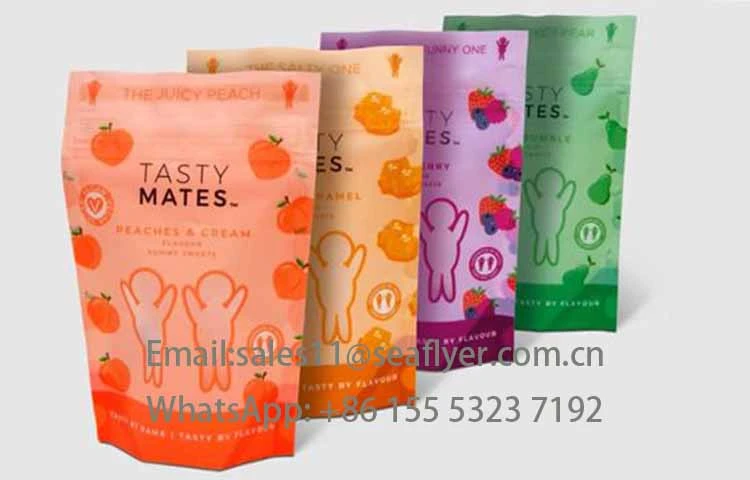
*Small-batch advantage: test multiple flavors and designs without large upfront investment.
Digital printing offers a more flexible approach. You can:
- Start with smaller quantities for market testing.
- Adjust packaging design based on customer feedback.
- Launch multiple product variations simultaneously.
- Reduce inventory risk and storage costs.
- Scale production as demand grows.
This approach is especially valuable for startups and brands exploring new product categories or markets.
8. What Information Should You Prepare Before Ordering?
To evaluate a digital printing project on mono-material film, it is helpful to prepare the following information:
| Specification | What to Provide |
|---|---|
| Product type | Coffee, granola, snacks, pet food, or other products |
| Bag style | Stand-up pouch, flat-bottom bag, or side-gusset bag |
| Material preference | PE-based or PP-based mono-material film |
| Bag dimensions | Width, height, and gusset |
| Film thickness | Required or preferred thickness |
| Printing design | Editable PDF or AI artwork |
| Ink requirements | Special brand colors or design requirements |
| Barrier requirements | Oxygen and moisture protection needs |
| Additional features | Zipper, valve, tear notch, or window |
| Order quantity | Estimated quantity per size and design |
| Target market | Country or region where the packaging will be sold |
*Production workflow: from design to sample approval to full-scale manufacturing.
If you are unsure which mono-material structure is suitable, start by discussing your product requirements and target market with your packaging manufacturer. The material should be selected based on actual packaging performance rather than sustainability claims alone.
Ready to Explore Digital Printing on Mono-Material Film?
Let LepuPouch help you explore a suitable packaging solution for your next product launch. Whether you need samples for testing or production-scale runs, our team can guide you through material selection, digital printing options, and recycling compatibility.
Get a free consultation and packaging sample →