

Non-chocolate candy grew from 33.3% of all-outlet U.S. confectionery sales in 2015 to 40.9% of the $55 billion market in 2025 (National Confectioners Association, 2026-03-09). Gummy packaging pouches are flexible laminated bags built to protect soft candy and functional gummies from factory to shelf. When matched to your formula, custom gummy packaging can help reduce clumping, save storage space, and improve shelf appeal. This guide covers bag styles, barrier films, closures, and supplier checks.

Editorial & Organization Note: Prepared by the packaging engineering team at LepuPouch under our editorial and privacy standards.
Key Takeaways
- U.S. confectionery sales hit $55.0 billion across all outlets in 2025, with non-chocolate candy at 40.9% share (NCA, 2026-03-09).
- In NCA's separate consumer report, Gen Z candy spending jumped 47% year over year (NCA, 2025-10-09).
- Stand-up pouches fit multi-serving SKUs, while 3-side seal bags suit single-serve samples.
- Three-layer films like PET/VMPET/LLDPE (90 to 120 microns example) block humidity and light.
- Covered products under CPSC 16 CFR Parts 1700–1702 may require child-resistant closures (U.S. CPSC, 2026-11-24).
- Digital printing supports a 500 pcs starting MOQ and a 7–15 day lead time when applicable, subject to project confirmation.
Why Confectionery and Supplement Brands Choose Flexible Pouches
Across all U.S. outlets, confectionery sales reached $55.0 billion in 2025 and are projected to reach $62.2 billion by 2030 (National Confectioners Association, 2026-03-09). Those displayed totals reflect a calculated five-year gain of $7.2 billion (NCA's narrative cites $7.3 billion before rounding). In 2025, chocolate held 51.7% and non-chocolate candy held 40.9%, while four major seasons drove 63% of sales.
Source: National Confectioners Association (2026 State of Treating), 2026-03-09. Note: 2015 (33.3%) and 2025 (40.9% non-chocolate, 51.7% chocolate) reflect all-outlet category shares; 63% is the separate seasonal share of annual sales.

In NCA's separate measured-channel study, non-chocolate candy reached $12.9 billion. That same report notes a 47% year-over-year rise in Gen Z candy spending (National Confectioners Association, 2025-10-09). Custom gummy packaging refers to made-to-order barrier bags printed and sized for a specific candy product and filling line. Unfilled flat pouches ship in compact cartons and need less warehouse space than rigid jars. Explore our custom flexible packaging solutions to see how laminated pouches run on automated lines.
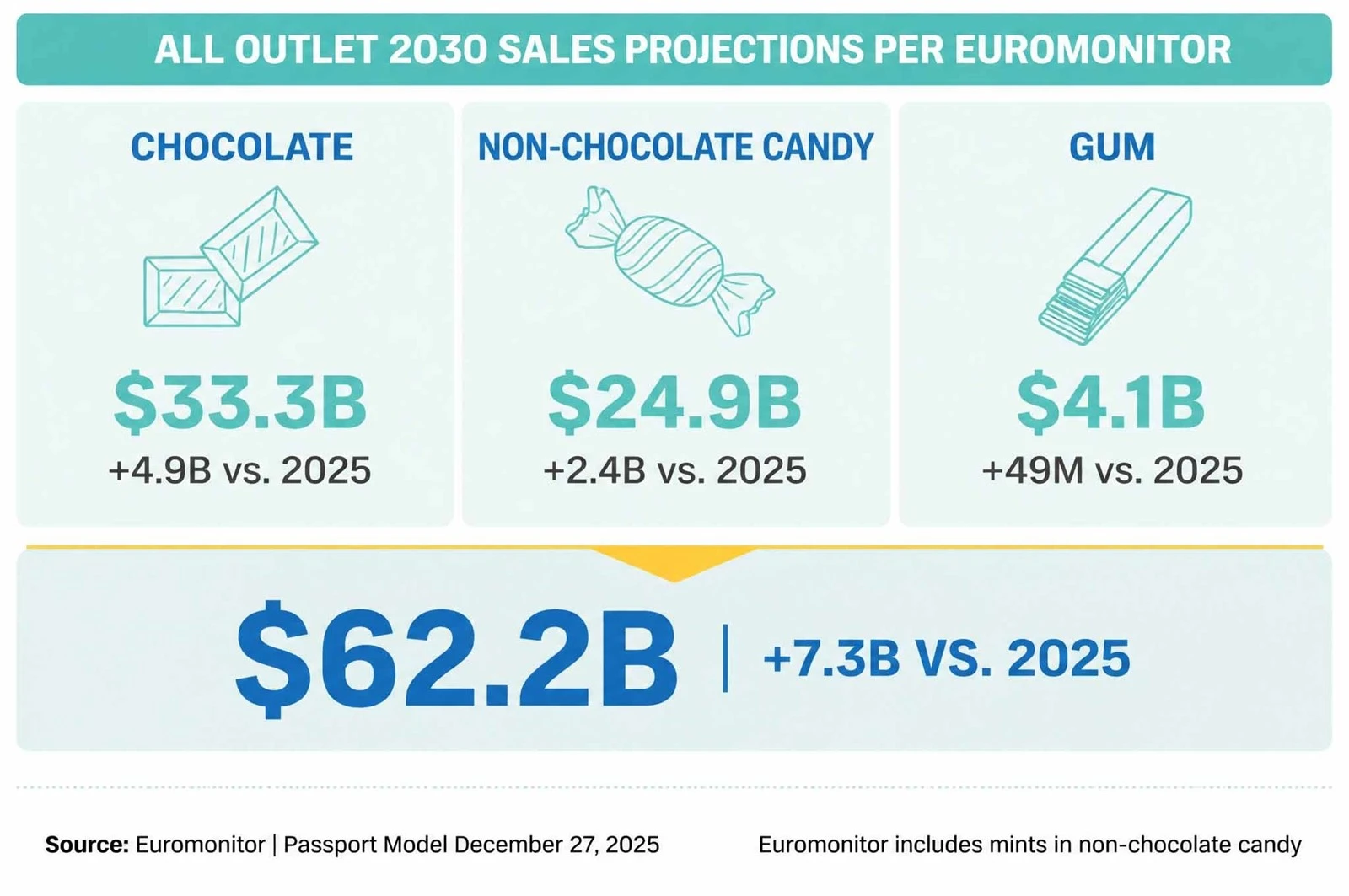
Source: National Confectioners Association, 2026 State of Treating (2026-03-09). The report's 2030 forecast assigns $33.3B to chocolate, $24.9B to non-chocolate candy, and $4.1B to gum, with a reported total of $62.2B and a reported increase of $7.3B vs. 2025. The $7.2B figure is the arithmetic difference between the rounded headline totals shown here ($62.2B − $55.0B); the report itself labels the increase +$7.3B. Euromonitor includes mints in non-chocolate candy.
What Pouch Styles Work Best for Gummy Packaging Pouches?
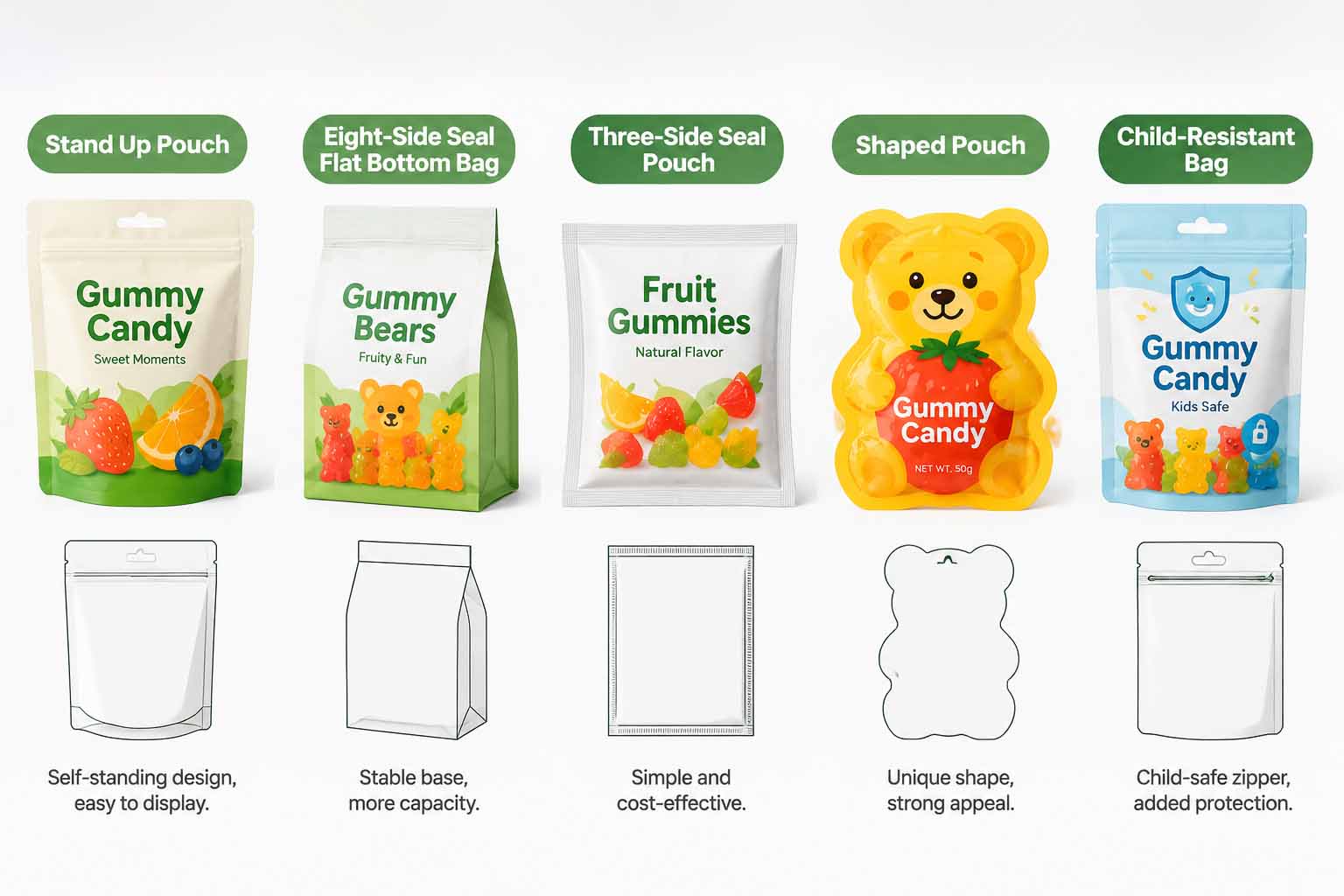
Selecting the right format for gummy packaging pouches depends on portion weight, display method, and filling speed. A bottom gusset is the folded base panel that expands when filled so a pouch stands upright. The fill weights below are illustrative supplier examples, not universal guarantees.
Stand-Up Pouches and Flat-Bottom Bags
Stand-up pouches are gusseted flexible bags that stand upright on shelves once filled. Their oval base opens wide under weighers and supports hang holes. For larger sizes, eight-side sealed candy stand-up pouches offer a flat base and five panels. For sample packs, three-side seal flat pouches with zippers reduce film usage and seal fast.
How Custom Gummy Packaging Prevents Sticking and Humidity Damage
Effective custom gummy packaging combines three film layers to prevent sugar sweating, clumping, and aroma loss. Gelatin and pectin gummies hold bound moisture that must stay balanced inside the bag. If humidity enters, sugar-sanded pieces clump; if moisture escapes, gummies harden.
Real humidity and light protection come from the middle barrier layer, not total film gauge alone. All thickness figures below are illustrative supplier examples rather than universal guarantees, so test samples with your formula.
Outer, Middle, and Inner Film Layers Explained
Each layer in a laminated candy bag handles a distinct job:
- Outer print layer (12 to 20 microns example): Polyester (PET) or BOPP resists sealing heat and holds reverse-printed ink.
- Middle barrier layer (VMPET, Foil, or EVOH): Metallized polyester (VMPET) reflects UV light and slows humidity transfer. EVOH provides clear protection for windows.
- Inner seal layer (50 to 80 microns example): Linear low-density polyethylene (LLDPE) or CPP melts cleanly to form airtight seams.

Inner Release Options and Recyclable Mono-PE Films
Oiled or pectin gummies can cling to smooth walls during warm transit. A slip additive or embossed inner PE sealant reduces friction when pouring candies. Mono-PE packaging is a single-polymer polyethylene film structure designed for PE recycling streams. Explore our recyclable plastic food bags to compare Mono-PE options; actual recyclability depends on local sorting facilities.
Closure Systems, Finishes, and Regulatory Compliance
Under U.S. FDA rules, the regulatory status of a food-contact material depends on each component expected to migrate to food (U.S. FDA, 2026-11-24). Covered pathways include indirect additives under 21 CFR Parts 174–179 (such as Part 177 polymers and Part 175 adhesives), GRAS substances, or effective FCNs. Under Section 303(c)(2) of the FD&C Act, buyers may ask the manufacturer for a Letter of Guaranty. Its scope depends on the formulation, intended use, supplier records, and destination market.
Press-to-Close vs. Child-Resistant Closures
Ordinary candy gummies sold as conventional food use press-to-close zippers. For sour gummies coated in sugar and citric acid, powder-resistant wide-channel zippers prevent track clogging.
Child-resistant pouches are locking flexible bags built to be significantly difficult for children under five to open while remaining usable by adults. Under the Poison Prevention Packaging Act (PPPA), 16 CFR Parts 1700–1702 govern regulated drugs and covered household substances (U.S. CPSC, 2026-11-24). Under Section 14(a) of the CPSA, the responsible manufacturer or importer of a covered product must issue a General Certificate of Compliance (GCC). Pouch test reports do not replace finished-product compliance review.
Surface Finishes and Viewing Windows
Outer finishes help differentiate your candy line on retail shelves:
- Matte and soft-touch coatings: Cut glare and give pouches a smooth feel.
- Glossy and spot UV finishes: Highlight fruit art against a matte backdrop.
- Clear viewing windows: Let shoppers inspect gummy color before buying.
How Do You Evaluate a Custom Gummy Packaging Supplier?
Retail and institutional food packaging is the largest segment in the U.S. flexible packaging industry (Flexible Packaging Association, 2026-11-24). When evaluating a factory, compare printing methods, MOQs, quality controls, and machine fit.
- Compare digital and rotogravure printing: Digital printing uses zero cylinder plates, fitting multi-flavor launches. Rotogravure uses engraved cylinders for large repeat orders.
- Confirm MOQ and lead-time terms: Standard MOQ is 500 pcs when applicable to the quoted packaging project. Digital printing typically takes 7–15 days when applicable, subject to project confirmation. Final MOQ, price, and lead time depend on pouch dimensions, material structure, printing process, order quantity, and production confirmation.
- Test sample bags on your line: Run sample pouches on your filler and heat sealer first. Check jaw temperatures, headspace, and opening speed.
- Verify factory quality systems: Published company profiles on the LepuPouch homepage and About page list ISO 9001, ISO 14001, and BRCGS credentials. Those pages also list HP Indigo 12000 presses and Cognex inspection systems. Ask suppliers for certificate numbers, audit scopes, and resin-level FDA 21 CFR or EU food-contact declarations.

Common Mistakes to Avoid When Ordering Bulk Gummy Bags
Avoiding these four oversights helps prevent launch delays:
- Skipping fill-volume tests: Gummy shapes settle differently inside a gusset. Fill sample bags with your target weight to check headspace.
- Mismatched heat-seal settings: Automated baggers run within specific temperature windows. Share machine specs with your supplier before laminating film.
- Using standard zippers on sour gummies: Sugar and acid crystals can clog narrow tracks. Specify a powder-resistant zipper for sanded formulas.
- Ignoring filling-room humidity: Packing gummies in a damp room traps moisture inside the bag. Keep filling rooms dry so the barrier film works well.
Frequently Asked Questions
What thickness is typical for custom mylar bags for gummies?
Many retail gummy pouches use 90 to 120 microns as an illustrative starting example. Single-serve flat bags may use 75 to 90 microns, while heavy packs often use 115 microns or more. Validate film gauge through drop tests.
How can brands reduce gummy sticking inside the pouch?
Specify a food-grade LLDPE or CPP inner sealant layer with a slip additive or embossed texture. Paired with a VMPET or foil barrier layer, this inner surface keeps humidity stable.
Can I split one low-MOQ digital run across multiple gummy flavors?
Yes, digital printing needs no engraved cylinders, allowing multi-SKU artwork splits when applicable. Standard MOQ is 500 pcs when applicable. Final pricing, MOQ, and lead time depend on pouch dimensions, material structure, printing process, order quantity, and production confirmation.
Do all gummy pouches require child-resistant closures?
No, standard candy gummies sold as conventional food use press-to-close zippers. Child-resistant closures under CPSC 16 CFR Parts 1700–1702 apply to regulated drugs and covered household substances. For covered products, the responsible manufacturer or importer must issue a GCC; pouch test data does not replace finished-product review.
Source Custom Gummy Packaging Pouches for Your Brand
Selecting reliable gummy packaging pouches requires matching your candy formula with tested barrier films and verified food-contact materials. Per published company information, LepuPouch manufactures custom pouches in ISO 9001, ISO 14001, and BRCGS-listed facilities. Individual food-contact layers are selected to meet applicable FDA and EU rules. See our privacy and site policy for disclosures, or contact our packaging team for custom gummy packaging samples and quotes.