

Selecting private label meat snack packaging starts with one priority: stopping oxygen, moisture, and sharp meat edges from spoiling cured snacks. For beef jerky, biltong, or smoked meat sticks, film laminate and seal geometry govern shelf stability.
This guide covers custom flexible packaging solutions, barrier film science, spoilage mechanisms, and food-contact compliance.
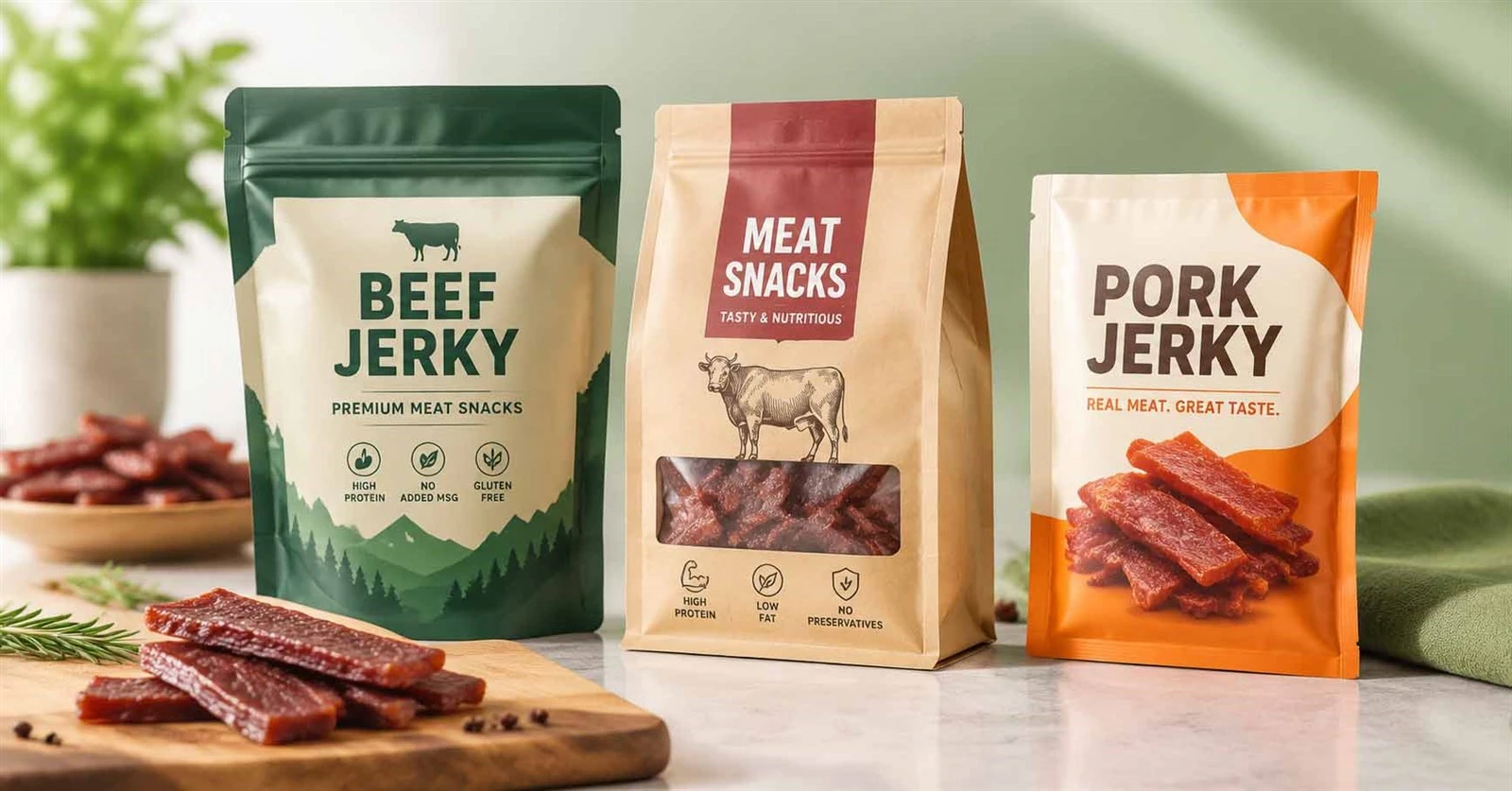
Below are the core takeaways for meat snack buyers evaluating barrier films and pouch formats.
Key Takeaways
Table of Contents
Which Pouch Formats and Features Work Best for Private Label Meat Snacks?
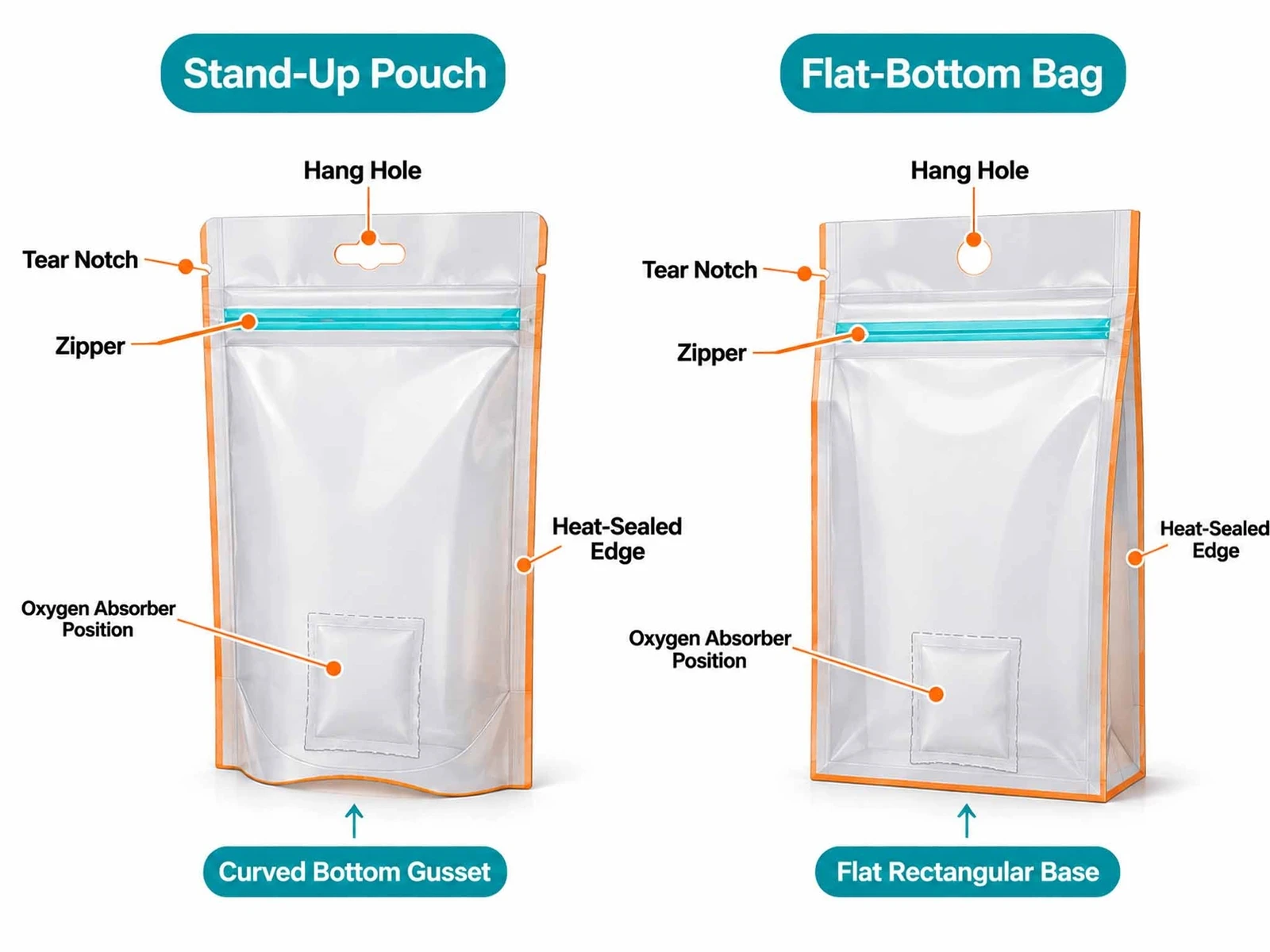
Stand-up pouches, flat bottom bags, and three-side seal pouches serve distinct retail roles based on pack weight and consumer usage. Match the pouch silhouette to how shoppers purchase and store your meat snacks.
See construction details in What is a Flat Bottom Bag (Box Pouch) (Flexible Pouches, retrieved 2026-11-10). Stand-up pouches fold a single bottom gusset with three or four seals. Flat bottom bags join three separate film webs across eight seal lines to create five printable panels and a flat base.
Functional Hardware for Co-Packer Lines and Repeat Use
Once you select a bag format, closures and die-cuts depend on your filling line and product cut:
What Are the Best High-Barrier Materials for Private Label Meat Snack Packaging?
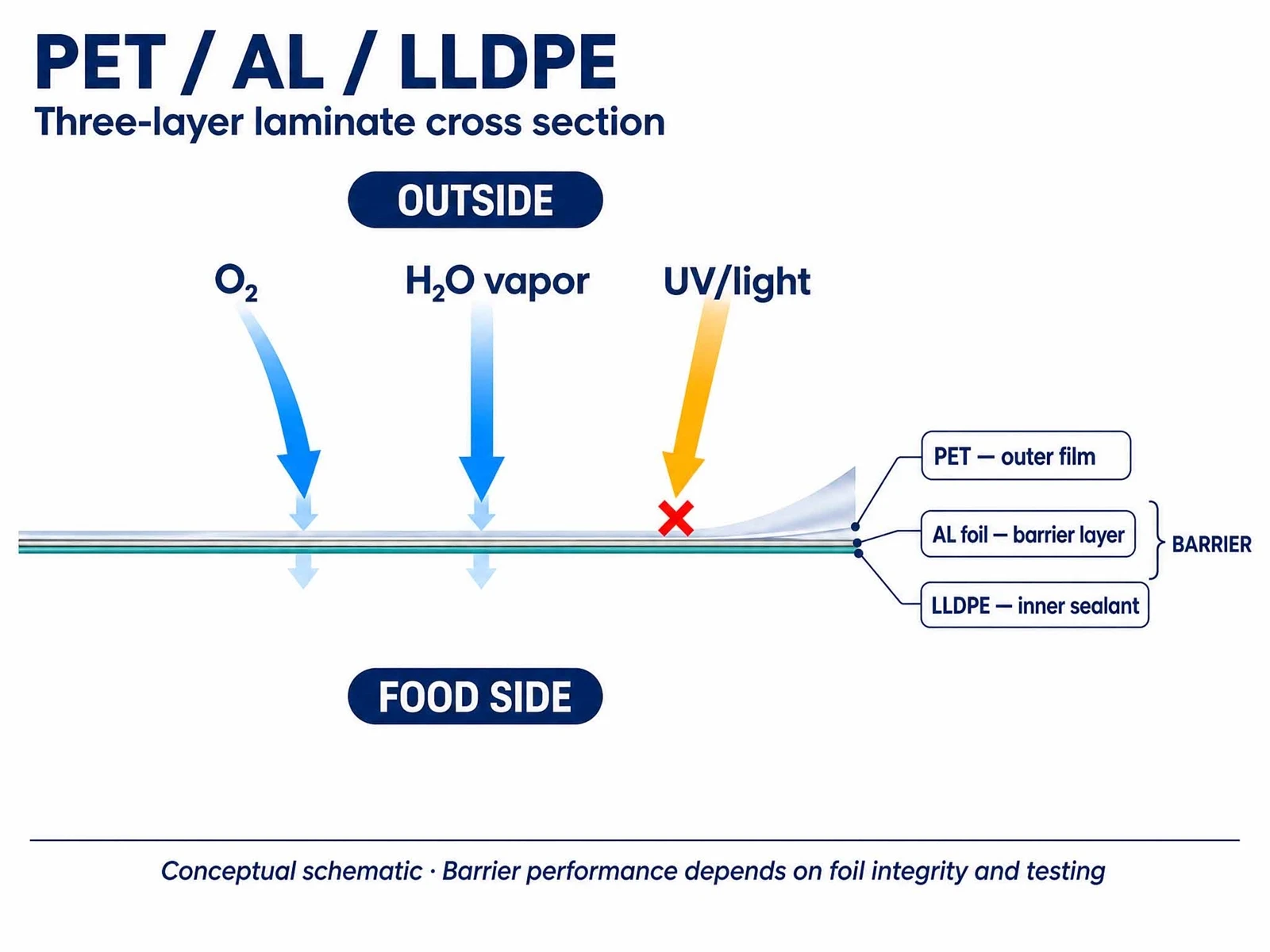
Multi-layer laminates combining polyester (PET), aluminum foil (AL) or metallized film (VMPET), and polyethylene (PE) protect dried meats from gas and moisture. See our jerky packaging bags and aluminum foil flat pouches for food. Per USU Extension's packaging guide, food-grade PET and foil laminate pouches sharply reduce oxygen and moisture transmission.
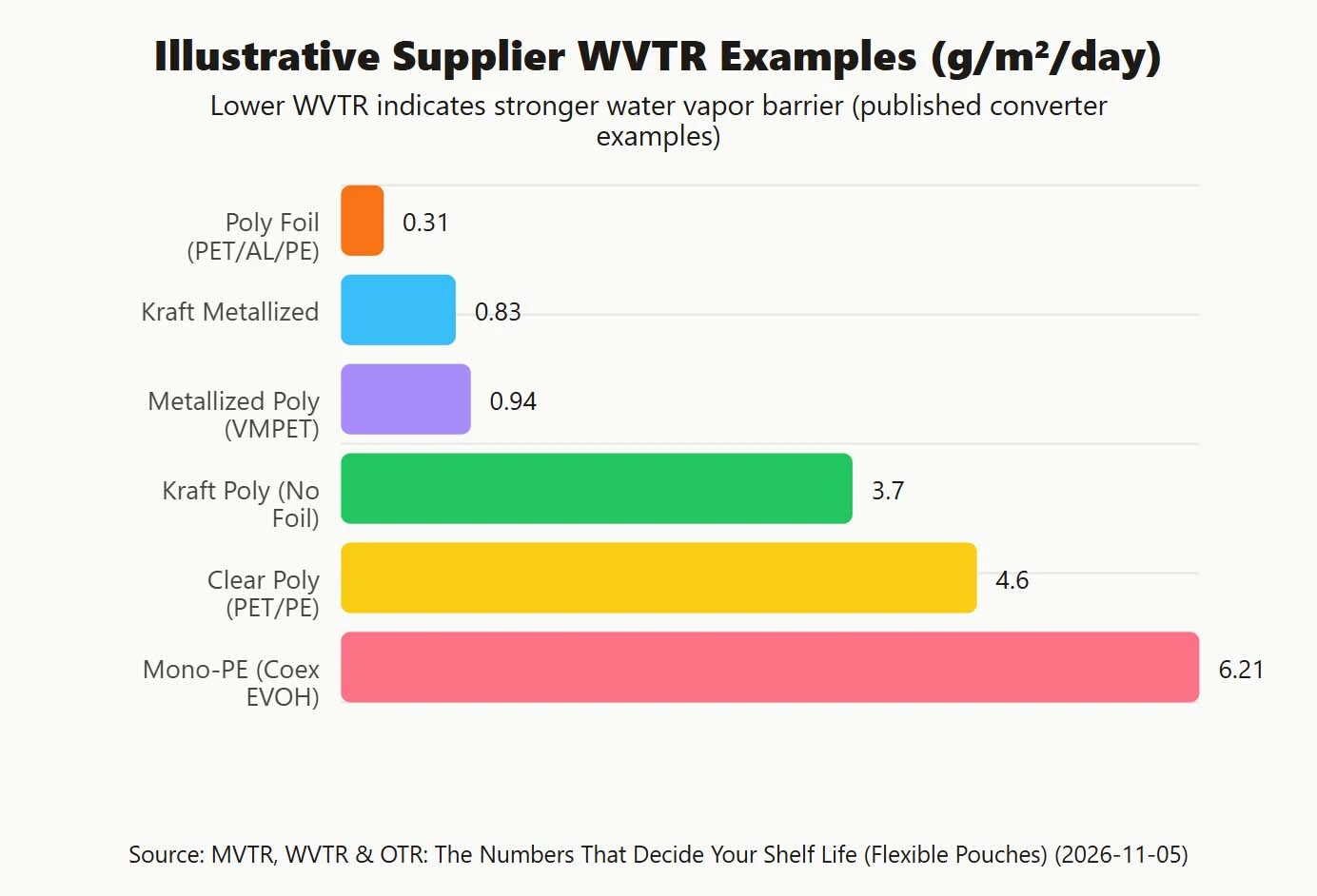
Total film thickness (mil or micron) never substitutes for a barrier core. See our high-barrier packaging guidance alongside the illustrative supplier data sheet examples in MVTR, WVTR & OTR: The Numbers That Decide Your Shelf Life (Flexible Pouches, 2026-11-05). A 5.20 mil kraft poly bag without foil reports 62.30 cc/m²/day OTR. A thinner 3.90 mil foil laminate reports 0.02 cc/m²/day OTR. It also lowers Water Vapor Transmission Rate (WVTR) to 0.31 g/m²/day.
Total film thickness (mil or micron) never substitutes for a barrier core. See our high-barrier packaging guidance alongside the illustrative supplier data sheet examples in MVTR, WVTR & OTR: The Numbers That Decide Your Shelf Life (Flexible Pouches, 2026-11-05). A 5.20 mil kraft poly bag without foil reports 62.30 cc/m²/day OTR. A thinner 3.90 mil foil laminate reports 0.02 cc/m²/day OTR. It also lowers Water Vapor Transmission Rate (WVTR) to 0.31 g/m²/day.
Methodology & Caveat: Values above are illustrative supplier flat-film examples from MVTR, WVTR & OTR (2026-11-05), not universal benchmarks. Supplier summary tables omit test temperature and humidity. Request lab test sheets (ASTM D3985 for OTR; ASTM F1249 for WVTR) and test finished pouches.
Balancing Puncture Resistance, Barrier Core, and Recyclability
Each layer in a meat snack laminate addresses a specific mechanical or chemical stress. For a meat-snack-specific product route, see beef jerky packaging bags:
Pragmatic sustainability trade-offs: See the 49-study review (2000–2016) on Wageningen University's repository (Yeh & Turan, retrieved 2026-11-10). Many biobased films show higher gas permeability than conventional laminates. Validate shelf life before switching to recyclable mono-material pouches or PCR flexible packaging. Actual disposal of recyclable or compostable films depends on local municipal recycling or industrial composting facilities.
Why Do Standard Pouches Fail Meat Snacks on the Shelf?
Standard single-layer poly bags fail cured meat snacks because fats oxidize rapidly, moisture shifts alter water activity, and sharp edges pierce thin webs.
1. Lipid Oxidation and Oxygen Permeation (OTR)
Per Utah State University Extension's Drying Meat guidance (Charlotte P. Brennand, retrieved 2026-11-10), residual fat in dried meat turns rancid when exposed to air and warm storage. OTR measures oxygen crossing a film per day (cc/m²/day, or cc/100 in²/day × 15.5).
Supplier guidelines in MVTR, WVTR & OTR classify high oxygen barrier films as those under 15.5 cc/m²/day. For long-life jerky, buyers typically test metallized or foil laminates under ASTM D3985 (23°C, 0% RH).
2. Water Activity Drift and Microbial Safety (WVTR)
Commercial jerky safety depends on controlling internal moisture and water activity (a_w). See the NMSU & USDA FSIS Beef Jerky Processing resource and UW–Madison Meat HACCP validation research (retrieved 2026-11-10). Both sources establish that shelf-stable dried meats require verified water-activity and moisture-to-protein ratio (MPR) critical limits. Those limits prevent pathogen growth (Staphylococcus aureus and Listeria monocytogenes) and mold at ambient storage (21°C).
WVTR is measured in g/m²/day under ASTM F1249 (38°C, 90% RH) and governs moisture transfer:
3. Seal Channel Leaks and EVOH Humidity Sensitivity
Flat-film data sheets represent best-case lab performance. In real transit, zipper tracks, gusset overlaps, and flex cracks allow extra gas ingress. Moreover, moisture weakens the oxygen barrier of nylon and EVOH layers. Request humid-condition OTR testing (ASTM F1927) and whole-pouch testing (ASTM F1307) before approving a film.
How to Plan Custom Printing, MOQs, and Food-Contact Compliance
See converter notes in What is a Flat Bottom Bag (Box Pouch). Digital presses (such as HP Indigo) need no printing plates, lowering setup barriers for multi-flavor runs. Rotogravure presses use engraved cylinders, lowering unit cost on larger production runs.
Disclosure: Final custom packaging pricing, MOQs, and production lead times depend on exact pouch dimensions, material structure, printing process, and order quantity.
Mandatory Food-Contact Regulatory Frameworks (US FDA & EU)
Meat snacks contain fats, salts, and spice oils that can trigger chemical migration from uncertified films or uncured adhesives. Buyers should verify two regulatory frameworks anchored by US GPO 21 CFR 177.1390 (retrieved 2026-11-10):
Frequently Asked Questions
Does a thicker pouch automatically give meat snacks a longer shelf life?
No. See supplier data in MVTR, WVTR & OTR. A 3.90 mil foil film (0.02 cc/m²/day) beats 5.20 mil kraft poly (62.30 cc/m²/day). Thickness adds puncture resistance, while the middle barrier core controls shelf life.
Do beef jerky bags need a degassing valve or an oxygen absorber?
Standard cured meat snacks use an oxygen absorber packet or nitrogen flushing rather than a one-way valve. Per USU Extension's packaging guide, oxygen absorbers maintain low sealed oxygen levels, whereas valves vent carbon dioxide from coffee.
Can private label meat snacks use a clear window without spoiling?
Yes, if the pouch uses a clear high-barrier laminate containing EVOH or oxide coatings (SiOx / AlOx) rather than plain PET/PE. Keep the window small to limit UV light discoloration.
How do I verify heat-seal strength across pouch gussets?
As detailed in Mono-Material PE vs Multi-Layer Pouches, pouches usually fail where film layers overlap at side seals and gussets. Run dye leak tests and ASTM F1307 whole-pouch oxygen checks on sealed samples.
When should a brand switch from digital to rotogravure printing?
Use plate-free digital printing for new flavors, seasonal packs, or multi-SKU test runs. Switch to rotogravure printing once single-SKU volume amortizes cylinder setup costs.
Conclusion: How to Specify Your Next Private Label Meat Snack Run
Specifying high-barrier private label meat snack packaging comes down to four verifiable steps:
Food-safety and regulatory guidance relies on Tier 1 government and university sources (USDA FSIS, 21 CFR, UW–Madison, NMSU, USU, and Wageningen). Laminate table figures represent illustrative converter examples requiring project-specific ASTM lab verification. Read about our packaging team,or contact our packaging specialists for sample bags.